
How do you turn down an expectation in Stable Diffusion?
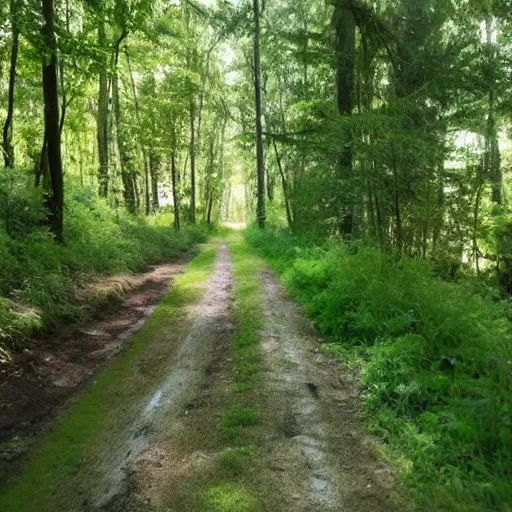
The words “dirt road” tell the model what to expect. The photograph tells it where the wheel tracks run and where the branches cross. Carhart-Harris and Friston’s REBUS hypothesis proposes that psychedelics can loosen the influence of high-level beliefs. I borrowed that idea by keeping the caption fixed and turning down its guidance scale. A separate control sets how much of the photograph reaches each frame.
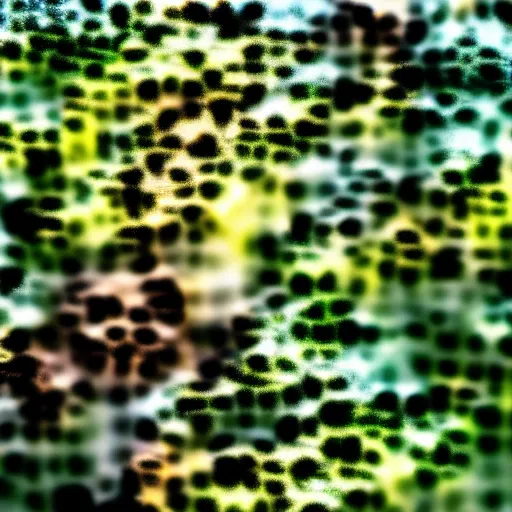
The harder question was where a pattern would come from. In Bressloff and colleagues’ model of visual cortex, connections between neighboring points help determine which shapes grow. In my experiment, gain simply amplifies features in one layer. Could the connections already in Stable Diffusion organize those features into a lattice or tunnel as the road faded? I tested that by measuring the spacing of the patches and checking whether they lined up under reflection or rotation.
Five brain-inspired controls in the image model
One road, one caption, three starting seeds
- 01I kept the model frozen and used the same caption throughout: “a view of a dirt road in the middle of a forest.”
- 02Every frame received the same aligned photo. The main runs used no spatial warp or injected pattern, and the starting noise was held fixed within each seed.
- 03Dose is a number that schedules the model settings. Four controls varied as it rose and fell over twelve simulated minutes. Depth stayed fixed at the first down block. Denoise strength also rose from 0.45 to 0.82, so the model started from more noise at the four-minute peak.
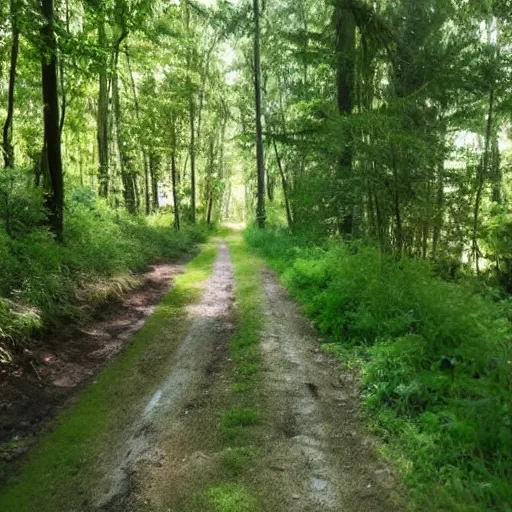
- 04I set the thresholds in advance. For return, the final frame had to score at most 0.05 in pixel error and at least 0.8 in fine-detail match against its own first render.
Two of six checks passed
What happened when I added structure or motion?
The peak spacing ranged from 20.5 to 46.5 pixels across seeds, and even a flat gray input produced repeating texture. A separate log-polar warp failed to increase the expected measures of radial order on either the flat field or the forest road.
I injected a hexagonal lattice directly into the first U-Net block. It had a mirror score of 1.000 at injection and averaged 0.066 in the rendered images over eight seeds. Where the layout was lost remains open.
Drifting the starting noise increased movement during a separate peak hold. Only two of three seeds sustained it. The tested full arc with drift missed both return thresholds, ending at 0.1498 pixel error and 0.028 fine-detail match.
- Peak spectral bump
- 1.80 vs 0.44 for the photo
- Mirror score after lattice injection
- 0.066 vs 1.000 at injection
The three-seed result comes from one photograph.
- The aligned source photo was available at every frame. In the one jittered-input run, final fine-detail match dropped to 0.686.
- Several settings changed together, so the time course cannot isolate the effect of any one control.
- The measurements describe rendered images. The study collected no participant reports or neural recordings.
- I designed the question, controls, and thresholds. I used AI tools for coding, research assistance, and manuscript drafting.